Overview of this talk:
\[\Phi(h,\nabla_{S^{n-1}} h) \det(\nabla^2_{S^{n-1}} h+hI)=f \qquad \text{ on }S^{n-1}\]| Minkowski problem | |
| dual Minkowski problem | aimed at recovering complicated convex shapes |
| Gauss image problem |
each one equivalent to solve a Monge-Ampère type equation
with connections to
differential geometry, optimal mass transport, geometric and functional isoperimetric inequalities, algebraic geometry, applied math, ...
The Monge-Ampère equation
\[\det(\nabla^2_{S^{n-1}}h +hI) = f \qquad\text{ on } S^{n-1}\]In $\mathbb{R}^n$, a convex body is a compact, convex set with non-empty interior.
Boundary shape can get much messier!
Question: What geometric quantities can be used to recover the shape of a convex body?
$\kappa(v)=$ Gauss curvature at boundary point $p$ with normal $v$
The prescribing Gauss curvature problem
Given a smooth positive $\kappa(v)$, what are the necessary and sufficient conditions on $\kappa$ so that is it the Gauss curvature function of some smooth convex body? Is this convex body uniquely determined?
Claim: there is a PDE!
Support function $h_Q:S^{n-1}\rightarrow \mathbb{R}$
Proposition
\[\frac{1}{\kappa_Q(v)}=\text{det}(\nabla^2_{S^{n-1}}h_Q(v)+h_Q(v) I)\]
The prescribing Gauss curvature problem
Given smooth positive $\kappa(v)$, existence and uniqueness of solution to
$\text{det}(\nabla^2_{S^{n-1}}h+h I)=\frac{1}{\kappa}?$
Remark: This does not work for a generic convex body!
For a generic convex body $Q$, one may define
surface area measure $S_{n-1}(Q,\cdot)$ on the unit sphere.
Intuitively: how surface area element is distributed according to normal vectors
(1) When $Q$ is a polytope:
(2) When $Q$ is smooth and strictly convex:
$\frac{dS_{n-1}(Q,v)}{dv}=\frac{1}{\kappa_Q(v)}.$
The Minkowski problem (1903)
Suppose $\mu$ is a Borel measure on $S^{n-1}$. What are the necessary and sufficient conditions on $\mu$ so that $\mu = S_{n-1}(Q,\cdot)$ for some convex body $Q$? Is this $Q$ uniquely determined?
Minkowski, Aleksandrov, Fenchel-Jessen, Lewy, Nirenberg, Pogorelov, Cheng-Yau, ...
Existence and Uniqueness Theorem
The Minkowski problem has a solution if and only if
\[\displaystyle \int_{S^{n-1}}vd\mu(v)=o.\]
Solution is unique up to a translation.
This condition reflects that surface area is translation-invariant in $\mathbb{R}^n$.
The importance of the Minkowski problem and its solution is to be felt both in differential geometry and in elliptic partial differential equations, on either count going far beyond the impact that the literal statement superficially may have. From the geometric view point it is the Rosetta Stone, from which several other related problems can be solved.
— Eugenio Calabi (Bull. Amer. Math. Soc, 1979)
The Brunn-Minkowski inequality
\[ \text{Vol}(Q+L)^\frac{1}{n}\geq \text{Vol} (Q)^{\frac{1}{n}}+\text{Vol} (L)^{\frac{1}{n}}, \]
with "$=$" iff $Q=tL+x$.
Quantitative stability result: Figalli-Jerison, 2017
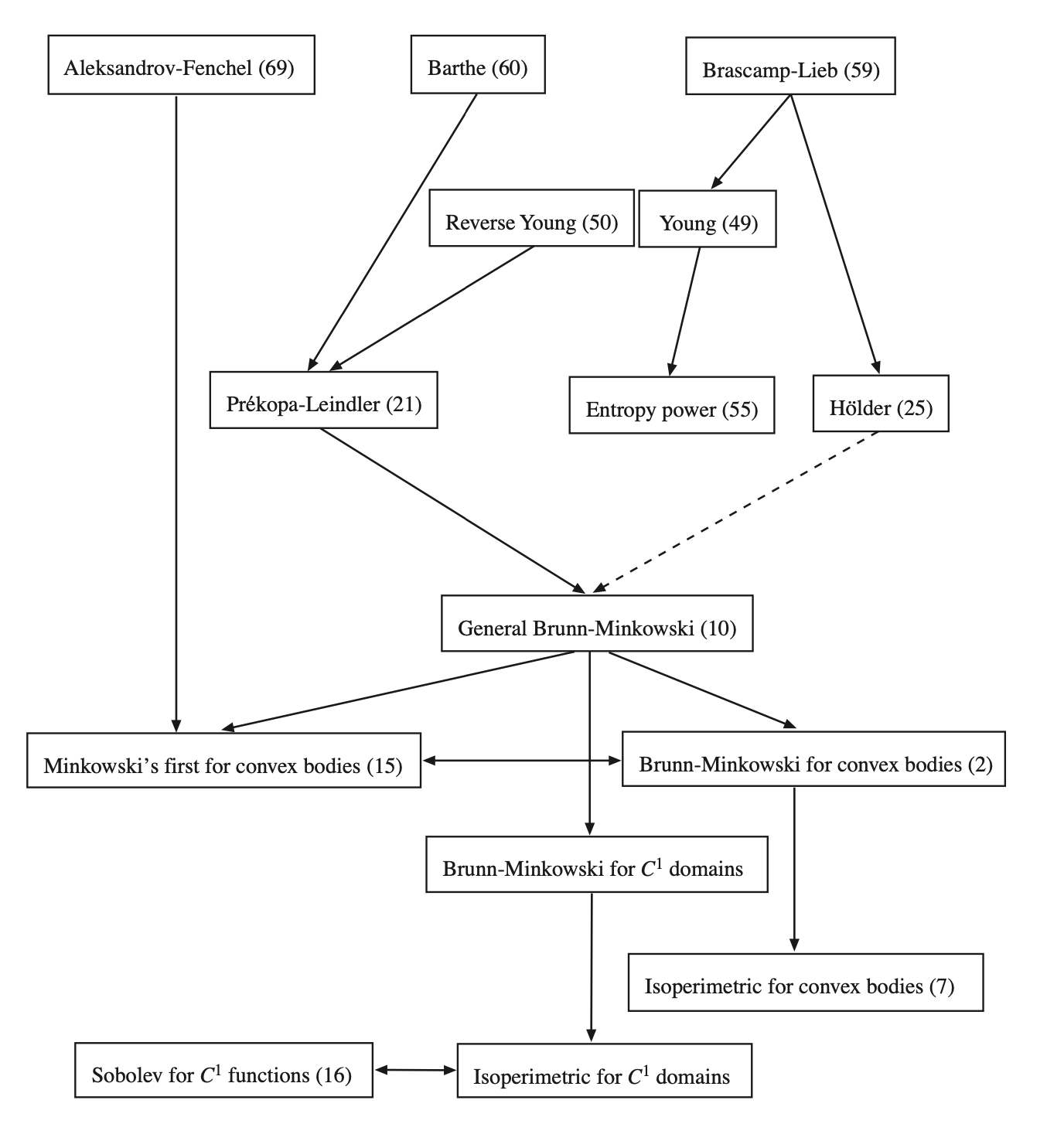
Minkowski's first inequality
\[ \int_{S^{n-1}}h_L(v)dS_{n-1}(Q,v)\geq \text{Vol}(Q)^\frac{n-1}{n}\text{Vol}(L)^{\frac{1}{n}}, \]
with "$=$" iff $Q=tL+x$.
There are many other curvature functions, e.g., mean curvature.
Q: without smoothness, what geometric measures replace them?
Aleksandrov's variational formula
Surface area measure is the "derivative" of volume.
\[ \frac{\partial}{\partial t}|_{t=0} \text{Vol}(Q+tL) = \int_{S^{n-1}} h_L(v)dS_{n-1}(Q,v), \]
for any convex body $L$.
$k$-th quermassintegral:
$W_k(Q) = \int_{G(n,k)}\mathcal{H}^{k}(Q|{\xi_k})d{\xi_k}$
Special cases: volume, surface area, mean width.
Steiner formula
\[ \text{Vol}(Q_t) = \sum_{i=0}^n {n\choose i}W_i(Q)t^{n-i} \]
Given $\omega\subset S^{n-1}$, we say $x\in A_t(Q, \omega)\subset Q_t\setminus Q$
if the associated radial direction is in $\omega$.
Given $\eta\subset S^{n-1}$, we say $x\in B_t(Q, \eta)\subset Q_t\setminus Q$
if the associated normal direction is in $\eta$.
The localized Steiner formula holds:
Vol$(A_t(Q, \omega))=\frac{1}{n}\displaystyle\sum_{i=0}^{n-1} {n\choose i}$$C_i(Q,\omega)$$t^{n-i}$
Vol$(B_t(Q, \eta))=\frac{1}{n}\displaystyle\sum_{i=0}^{n-1} {n\choose i}$$S_i(Q,\eta)$$t^{n-i}$
(Federer's) curvature measures $C_i(Q,\cdot)$: smooth case, elementary symm functions of principal curvatures
area measures $S_i(Q,\cdot)$: smooth case, elementary symm functions of principal radii of curvature
Minkowski-type problems can be posed for all area measures and curvature measures.
The Aleksandrov problem: for $C_0(Q,\cdot)$, completely (existence and uniqueness) solved by Aleksandrov.
The Christoffel problem: for $S_1(Q,\cdot)$, Aleksandrov, Blaschke, Firey, Grinberg-Zhang, Pogorelov, ...
The Christoffel-Minkowski problem: for $S_{i}(Q,\cdot)$, Guan-Ma, Sheng-Trudinger-Wang, ...
For $C_i(Q,\cdot)$: Guan-Guan...
$k$-th quermassintegral:
$W_k(Q) = \int_{G(n,k)}\mathcal{H}^{k}(Q|{\xi_k})d{\xi_k}$
$k$-th dual quermassintegral:
$\widetilde{W}_k(Q) = \int_{G(n,k)}\mathcal{H}^{k}(Q\cap\xi_k)d{\xi_k}$
dual Steiner formula
\[ \text{Vol}(\widetilde{Q}_t) = \sum_{i=0}^n {n\choose i}\widetilde{W}_i(Q)t^{n-i} \]
Essential difference caused by lack of smoothness of the body
Given $\omega\subset S^{n-1}$, we say $x\in \widetilde{A}_t(Q, \omega)\subset \widetilde{Q}_t\setminus Q$
if the associated radial direction is in $\omega$.
Given $\eta\subset S^{n-1}$, we say $x\in \widetilde{B}_t(Q, \eta)\subset \widetilde{Q}_t\setminus Q$
if the associated normal direction is in $\eta$.
Huang-Lutwak-Yang-Zhang (Acta, 2016)
The localized dual Steiner formula holds:
Vol$(\widetilde{A}_t(Q, \omega))=\frac{1}{n}\displaystyle\sum_{i=0}^{n-1} {n\choose i}$$\widetilde{C}_i(Q,\omega)$$t^{n-i}$
Vol$(\widetilde{B}_t(Q, \eta))=\frac{1}{n}\displaystyle\sum_{i=0}^{n-1} {n\choose i}$$\widetilde{S}_i(Q,\eta)$$t^{n-i}$
dual curvature measures $\widetilde{C}_i(Q,\cdot)$
dual area measures $\widetilde{S}_i(Q,\cdot)$
In the smooth case
The dual Minkowski problem
Suppose $\mu$ is a finite Borel measure on $S^{n-1}$ and $1\leq i\leq n$ is an integer. What are the necessary and sufficient conditions on $\mu$ so that $\mu=\widetilde{C}_i(Q,\cdot)$ for some $Q$? Is such $Q$ uniquely determined?
Z. (JDG, 2018); Böröczky-Henk-Pollehn (JDG, 2018)
The dual Minkowski problem has a solution in the symmetric case if and only if \[ \frac{\mu(S^{n-1}\cap \xi_k)}{\mu(S^{n-1})} < \color{red}{\min\left\{\frac{k}{i},1\right\}}, \] for every $k$ and $k$-dimensional proper subspace $\xi_k$.
When $\mu$ has a smooth density, Li-Sheng-Wang (JEMS, 2020) obtained the solution in the symmetric case using geometric flow.
The Gauss image problem
The radial Gauss map $\alpha_Q: S^{n-1}\rightarrow S^{n-1}$
The Gauss image problem
Suppose $\mu$ and $\nu$ are two probability measures on $S^{n-1}$. When can $\mu$ be transported to $\nu$ via the radial Gauss map of some convex body?
The optical reflector design problem
L. Caffarelli, V. Oliker, X.J. Wang, ...
Böröczky-Lutwak-Yang-Zhang-Z. (CPAM, 2020)
There is a $Q$ whose radial Gauss map transports $\mu$ to $\nu$ if \[ \color{green}{\nu(\omega)<\mu(S^{n-1}\setminus \omega^*)} \] for each spherical convex set $\omega\subset S^{n-1}$.
Böröczky-Lutwak-Yang-Zhang-Z. (CPAM, 2020)
There is a $Q$ whose radial Gauss map transports $\mu$ to $\nu$ if \[ \color{green}{\nu(\omega)<\mu(S^{n-1}\setminus \omega^*)} \] for each spherical convex set $\omega\subset S^{n-1}$.
The dual Minkowski problem: when is $\mu=\widetilde{C}_{i}(Q,\cdot)$?
\[ \frac{1}{n}h_Q(v)|\nabla_{S^{n-1}}h_Q(v)+h_Q(v)v|^{n-i}\text{det}\left(\nabla^2_{S^{n-1}}h_Q(v)+h_Q(v)I\right)=f(v) \]Z. (JDG, 2018); Böröczky-Henk-Pollehn (JDG, 2018)
The dual Minkowski problem has a solution in the symmetric case if and only if \[ \frac{\mu(S^{n-1}\cap \xi_k)}{\mu(S^{n-1})} < \color{red}{\min\left\{\frac{k}{i},1\right\}}, \] for every $k$ and $k$-dimensional proper subspace $\xi_k$.
Variational formula. Huang-Lutwak-Yang-Zhang (Acta, 2016)
where $Q_t=[h_Qe^{tf}]$.
The variational problem
\[ \sup {\Big\{}-\frac{1}{|\mu|}\int_{S^{n-1}}\log h_Q d\mu +\frac{1}{i} \log \widetilde{W}_{i}(Q)\Big\} \]where $Q$ is $o$-symmetric.
Lemma
If a maximizer is obtained at $Q$, then $Q$ solves the dual Minkowski problem.To show maximizer exists: uniform $C^0$ upper and lower bound.
Remaining cases:
- $i>n$
- non-symmetric case, including the smooth case
- uniqueness/isoperimetric inequality
Future work:
- Minkowski-type problems in other measure spaces (e.g., Gaussian probability space): loss of homogeneity and translation invariance
- Minkowski-type problems for noncompact convex hypersurfaces
- convex body with optimal mass transport, and probability theory
- Take a maximizing sequence $Q_j$.
- By homogeneity, rescale so that $Q_j$ is uniformly bounded.
- The Blaschke Selection theorem: can take a convergent subsequence.
- Derive lower bound --- $C^0$ estimate, John's lemma, "barrier convex body"=generalized cylinder